
by Bob Hess, W1RH with help from Rick Samoian, W6SR
Since it’s the end of the year, and since Jeff is always asking for Nugget articles, I thought I’d bring all of you up to date on what Rick, W6SR, and I have been doing with remote operation from my station.
A couple of years ago, Rick asked me about remoting into my station. Rick had been using Fred’s (KH7Y) station, but Fred was in the process of moving to New Mexico.
At that time, my station was set up for SO2R, using a Flex 6700, an Alpha 91B amp and an Ameritron ALS-1300 amp. Antennas consisted of a Force12 C19XR on Tower 1 and two Cushcraft A3S’s on Tower 2. I also had an 80 meter sloper, a 160 meter dipole and a 40 meter rotatable dipole on Tower 1. A loop, placed way down the hill, has been used for receiving.
My location sits on 10.5 acres, 100 feet below the top of a north-south ridge, on the east side. The top of the mountain is 1,800 feet and my lot is 1700 feet at the top and about 700 feet at the bottom…..a very steep fall-off from about 0 degrees to 200 degrees. Much of the Pacific is blocked by the top of the ridge. I can work Europe and Africa, however, when conditions are such that many others cannot. Same goes for the Caribbean and South America.
Rick, who had moved into a community with antenna restrictions, had a Flex Maestro, a Flex 6500 and various items leftover from his previous QTH.
With Flex equipment, it’s very easy to remotely control the radio, but that’s it. When Rick first started using my station, I would have to manually change frequency on the amps and change antennas on the Array Solutions SO2R switch.
A lot has changed since then.
One of the first changes was an EA4TX Remote Box that Rick purchased. This allowed the Array Solutions SO2R switch to be remotely controlled and has been very reliable over the past two years.
Later, I was able to remote the ALS-1300 but it had no 6 meter capability. Instead, Rick purchased an ALS-1306 and later an Acom 1200S. At one time or another, I used all three of these amps for the second side of the SO2R switch but the 91B remained in place as my primary amp.
The next step was to install a 5 element KLM 6 meter Yagi that Rick had in storage. We decided to put up a single section of Rohn 25 and put the antenna at about 10 feet above ground on the edge of a very steep drop-off. It has performed well.
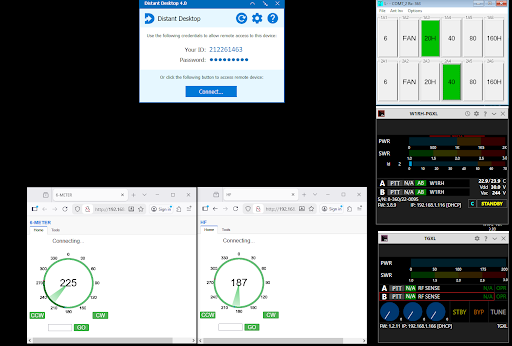
Over this period, I was playing around with various remote desktop programs and settled on a program called Distant Desktop. It’s free and very reliable and Rick uses this program to control just about everything at the station. I added two of Stefan AF6SA’s remote antenna controllers, which appear on the desktop. Also, we used an app for the Acom but there was no app available for the Ameritron amps.
Things really changed for the better as I was wondering the flea market at the Dayton Hamvention this past May. I found a contester selling his 4O3A/Flex Power Genius Amp, Tuner Genius 2 KW tuner, and his Antenna Genius 8×2 antenna switch. We did a PayPal fund transfer and all three items belonged to me. All I had to do was to get them back to California. I should note that the Dayton Hamvention is incredibly organized and has folks standing by with golf carts to carry goods from the flea market out to the buyer’s cars. Wonderful! Once I had it in the rental car, I found a UPS store and $250 later all three boxes were on their way to California.
What is wonderful about adding the 4O3A/Flex devices to the station is that Flex devices talk to each other via Ethernet. This means that serial cables, USB cables, PTT cables etc. are not needed. To tie them all together, I just used the Ethernet connector and coax connectors on each device. Currently, I have yet to install the Antenna Genius switch but we have been using the amplifier and the tuner and they have been incredibly reliable. The amp will easily do 2 KW if you don’t watch your power. Both the tuner and amplifier are configured for SO2R, so no other boxes are required for a SO2R operation other than the 6700 radio, amp and tuner.
Another benefit of using all Flex equipment is that both the Maestro and SmartSDR (Flex software) now have amplifier windows built into the display. This way, when you’re looking at the screen, with the waterfall, frequency and all radio controls, you’re also seeing amp input power, output power, and temperature.
All of this now gives Rick and I a full power remotely controlled SO2R station. There has been no hurry to install the Antenna Genius switch since the EA4TX controller with the Array Solutions antenna switch works so well, but I will get around to replacing the Array Solutions switch with the Antenna Genius switch this spring.
This is what Rick sees on the Distant Desktop display at his house:
While the remote desktop idea is working fine, it’s nowhere near as cool as using Node Red to control everything. I’m working on that and we will be moving station control over to Node Red in the upcoming year.
One problem for us has been dealing with the contest log when Rick and I do a multi-op. I’ll put N1MM up on the remote desktop computer and we both use that and, while it works, there are other issues involving the Flex’s DAX and CAT requirements, which I need to manually switch over when one of us takes over as the operator. All of this is going away as I write this. I’m switching the logging over to a VPN with a well-established N1MM method using Hamachi VPN software. We will have this running for the RTTY Roundup. This will allow Rick to have his own log on his own computer, with the windows arranged the way he likes them. Same with me. It also allows Rick to run his own Flex CAT and DAX and likewise the same with me. With Flex Multiflex, we can both be logged into the 6700 simultaneously, and this goes for anyone else who wants to join the multi-op. It makes everything seamless and as if all operators were in the same room.
Rick and I have also been playing around with antennas. While I was doubtful, Rick suggested we put up a 160/80/40 meter Fan Dipole off of the 50 ft Tower 2, which is about 300 feet down the hill. We have been dealing with quite a bit of RF noise, from the house that I’ve yet to fix. The A3S’s on Tower 2 (far away from the house) are very quiet, generally with a noise level under S2. Many times, I have used one of the A3S’s as a receiving antenna while transmitting from the Force 12 on Tower 1.
Well, Rick was right. The Fan dipole works incredibly well and we used it for the ARRL 160 contest a few weeks ago. We didn’t even need to use the receiving loop. Noise on 80 and 160 was S2 or lower. The steep slope makes this dipole (actually Inverted VEE) electronically appear much higher than it actually is.
There’s one more change we have made this year. Until now, Rick’s Flex 6500 has been sitting in storage at my place just in case the 6700 fails. Well, that’s a waste, so Tyler, K6TLR, and I put up a Cushcraft R7000 vertical, I had lying around, on a part of the property well removed from the other antennas. it works incredibly well. This antenna covers 6, 10, 12, 15, 17, 20, 30, and 40 meters with a SWR of well under 2:1 on each band. In two days, I worked all over the world with 100 watts and FT8, and this includes Europe on both 40 and 30 meters. The original thought was that this gives Tyler a radio to use or something Rick or I can play with when the big station is in use. Another idea popped into my head however: Let some of the new hams, with general licenses but no radios or HF antennas learn to use FT8 and even do contests such as the North American QSO Party. Since there is no amp to control and no antenna switch is required, the operator just needs to have a copy of SmartSDR to begin using the radio. [late note: the antenna recently suffered some damage so is out of action until repaired.]
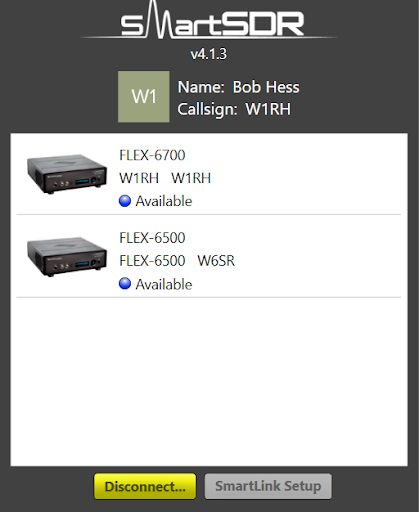
This is what the SmartSDR window looks like when two radios are available. When logging in, you simply click on the radio you want to use.
So that’s what’s been going on over the past year or two at my station. I should mention that one project that never got done was installing a brand new SteppIR DB-18. For several reasons, this antenna will probably never go up. If you have something like a C3 and a two element 40 meter beam and want to trade, let me know!
2026 should see the Antenna Genius switch installed but we also want to clean up the noise problem on the antennas close to the house. The biggest culprit seems to be an APC Smart UPS 1500 which generates a lot of noise. Also, the grounding is very limited and we have plans to fix that.
In the process of making a lot of these station changes, I pulled out all of the SO2R bandpass filters. This has put a dent in high-power SO2R but the antennas are spaced far enough apart so that a contest like NAQP, with low power, allows SO2R operation without interference. This will all be fixed in 2026.
Finally, the entire station – everything – will be rack mounted and installed in a corner of the garage. I’ll be building a new operating position with computers in front of me to control everything.
Comments
One response to “W1RH Year End Remote Station Update”
[…] W1RH Year End Remote Station Update – Bob W1RH […]