To have your favorite QSL card featured in the Nugget, just email Bob W1RH an electronic copy or trust him with a hard copy and he will scan it and return it to you in the same condition he received it.
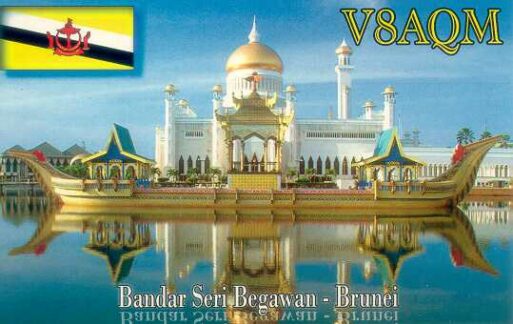
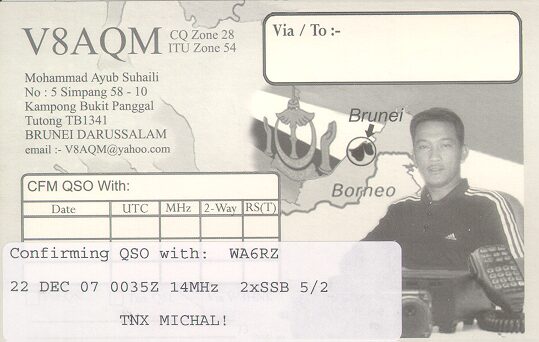
I got this card from Michal, WA6RZ, who lives in El Dorado Hills. He worked Mohammad, V8AQM, in 2007, on 20 meter SSB.
“In 2025, Brunei, was listed at #141 on the most wanted DXCC entities. It took me a while to work it, but activity has gone up in recent years. The prefix, prior to independence, was VS4. The Sultanate of Brunei’s influence peaked between the 15th and 17th centuries when its control extended over coastal areas of northwest Borneo and the southern Philippines.
“Brunei subsequently entered a period of decline brought on by internal strife over royal succession, colonial expansion of European powers, and piracy. In 1888, Brunei became a British protectorate; independence was achieved in 1984. The same family has ruled Brunei for over six centuries and is an absolute monarchy. Brunei benefits from extensive petroleum and natural gas fields, the source of one of the highest per capita GDPs in Asia.”
To have your favorite QSL card featured in the Nugget, just email Bob W1RH an electronic copy or trust him with a hard copy and he will scan it and return it to you in the same condition he received it.
This month’s card comes from my collection.
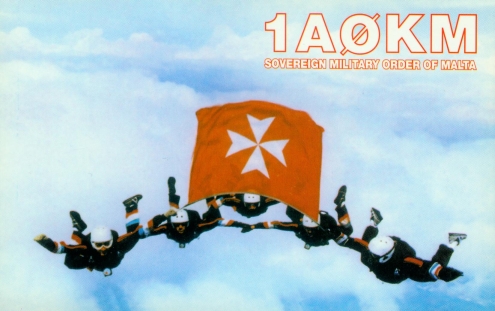
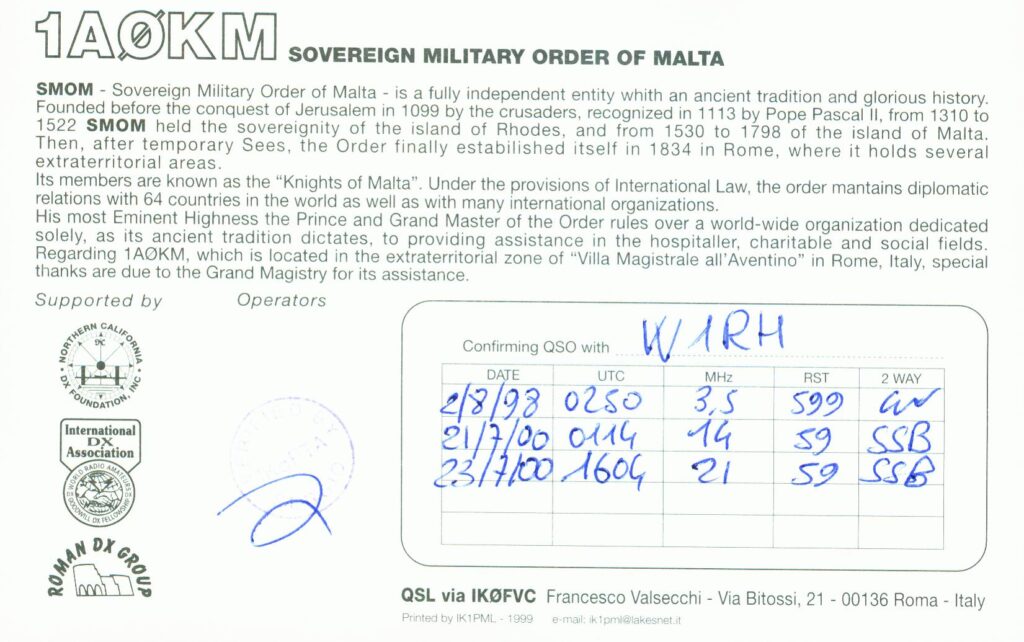
I worked 1A0KM three times. Once, in August, 1998, on 80 meter CW, and twice in July, 2000, on 10 and 15 meter SSB. All contacts were made from my Massachusetts QTH.
Did you know that the Sovereign Military Order of Malta is a DXCC Entity? From the back of the QSL card:
The Sovereign Military Order of Malta is a fully independent entity with an ancient tradition and glorious history. SMOM was founded before the conquest of Jerusalem, in 1099, by the crusaders, and recognized in 1113, by Pope Pascal II. From 1310 to 1522, SMOM held the sovereignty of the island of Rhodes, and from 1530 to 1798, of the island of Malta. Then, after temporary Sees, the Order finally established itself in 1834 in Rome, where it holds several extraterritorial areas.
Its members are known as the “Knights of Malta”. Under the provisions of International Law, the Order maintains diplomatic relations with 64 countries in the world aswell as with many international organizations.
His most Eminent Highness, the Prince and Grand Master of the Order rules over a world-wide organization dedicated solely, as its ancient tradition dictates, to providing assistance in the hospitaller, charitable, and social fields.
Regarding 1A0KM, which is located in the extraterritorial zone of “Villa Magistrale all ‘Aventino”, in Rome, Italy, special thanks are due to the Grand Magistry for its assistance.
From G4UCJ’s site.
Sometimes a station could be quite close geographically but still classed as DX because the area they are transmitting from is very rarely heard on radio, for instance take the station 1A0KM, operating from Italy. Italy is not usually classed as DX on the HF bands BUT the 1A0 prefix makes this part of Italy very rare. 1A0KM is the station of the ‘Sovereign Military Order of Malta’ which qualifies as a separate entity (or country as they used to be called). 1A0KM is only activated maybe once or twice a year at best and is only on for a few hours at a time (this is a deliberate decision by the SMOM), so trying to work this station is very difficult indeed despite the fact it is only in Italy. It is not the signal strengths that stop you from working it—signals from this station are usually quite good. What does stop you is the sheer volume of other stations calling at the same time (a ‘PILE UP’!).
From the 1A0C website:
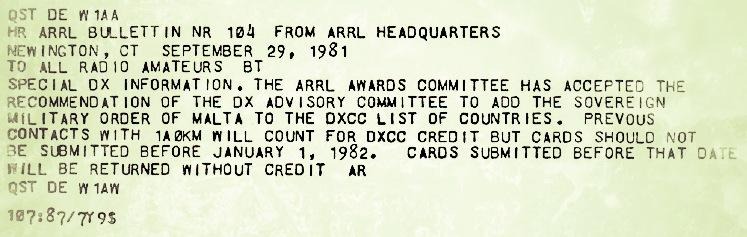
With this telegram, ARRL added the Sovereign Military Order of Malta as a DXCC Award eligible entity. Starting January 1st, 1982 the cards of QSOs with 1A began to be checked and approved to the great pleasure of all who would pursue DXCC. Now, some 30 years later thist the prefix is still quite needed by DXers from the amateur Radio community.
And, regarding the prefix, per Wikipedia:
Some call sign block ranges are unassigned by the ITU, e.g. the 1AA-1ZZ block. Any call sign used by an amateur in these unassigned block ranges usually had it assigned to them by a group with an unrecognized national claim. Unless otherwise noted, they have no value for DXCC awards.
1A is used by the Sovereign Military Order of Malta a Roman Catholic order based in Rome, Italy.[14] This entity is recognized by ARRL for the DXCC program
To have your favorite QSL card featured in the Nugget, just email Bob W1RH an electronic copy or trust him with a hard copy and he will scan it and return it to you in the same condition he received it.
Raise your hand in you recognize the call, Kilo-1-Juliette-Tango. Something about that call sounds familiar!
Here’s a clue:
WSJT – WS-JULIETTE-TANGO
JTDX – JULIETTE-TANGO-DX
JT ALERT – JULIETTE-TANGO-ALERT
How about this clue:
FT8 – FOX-TANGO-8
So, by now, you should have figured out that K1JT has something to do with FT-8 and some of the software programs associated with FT-8.
FT-8 is now the most popular HF mode, and Joe Taylor had a lot to do with it. FT8 was developed by Joe Taylor, K1JT, and Steve Franke (THE “F” in “FT-8”), K9AN, and released in 2017 as part of the free software package, WSJT-X. The name stands for “Franke-Taylor design, 8-frequency shift keying” (8-FSK) modulation.
Per Wikipedia:
WSJT-X is a computer program used for weak-signal radio communication between amateur radio operators. The program was initially written by Joe Taylor, K1JT, but is now open source and is developed by a small team. The digital signal processing techniques in WSJT-X make it substantially easier for amateur radio operators to employ esoteric propagation modes, such as high-speed meteor scatter and moonbounce. Additionally WSJT is able to send signal reports to spotting networks such as PSK Reporter.
JTDX evolved from WSJT-X and, in my opinion, is a better program for DX’ing, especially when combined with JTAlert, which provides visual and audio alerts and text-messaging, to enhance the digital weak-signal modes like FT8/FT4. It also helps hams find needed callsigns, track award progress (WAS, DXCC), and automate logbook entries. It monitors band activity, flags desired stations or entities, and integrates with logging programs, reducing manual searching and improving the user experience for chasing contacts.
Joe Taylor also held the calls, K2ITP, WA1LXQ, W1HFV, and VK2BJX. In his career, Joe is an astrophysicist and Nobel Prize laureate in Physics for his discovery with Russell Alan Hulse of a “new type of pulsar, a discovery that has opened up new possibilities for the study of gravitation.” (Wikipedia)
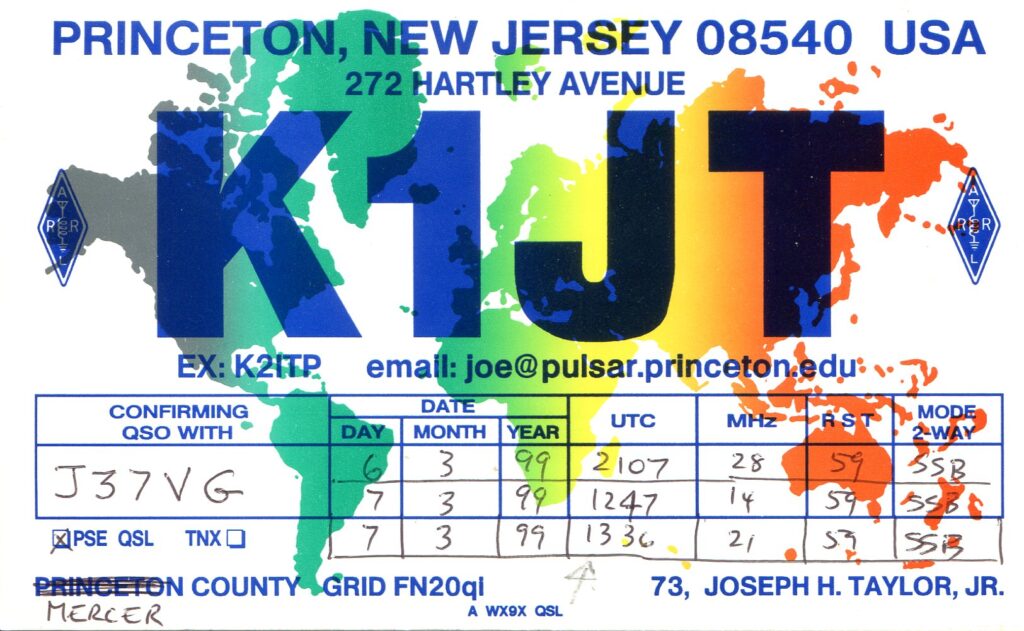
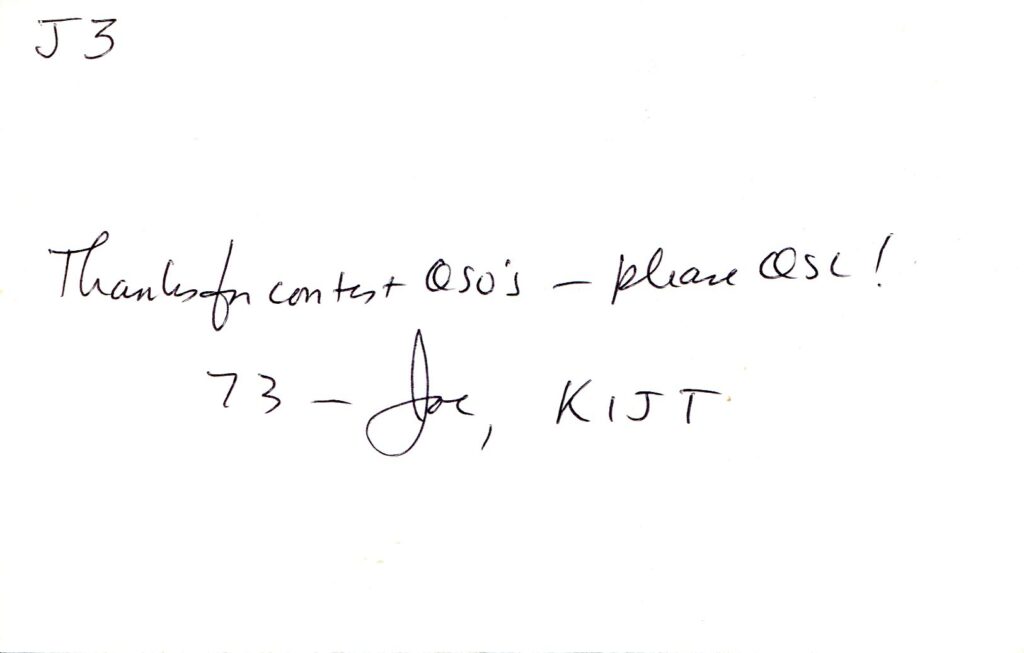
I found Joe’s QSL card the other day, in a pile of cards I was going through prior to throwing them out. I kept a few, and this was one of them. Frankly, I did a double-take when I saw the call. I knew the call sign, but I sure didn’t expect to see K1JT’s card in the stack. So, how did I get this QSL card? K1JT worked J37VG on 10, 15, and 20 Phone during the ARRL 1999 DX Contest. AA1IZ, K1EP and I were the J37VG team. I’ll have more to say about J37VG next month.
To have your favorite QSL card featured in the Nugget, just email Bob W1RH an electronic copy or trust him with a hard copy and he will scan it and return it to you in the same condition he received it.
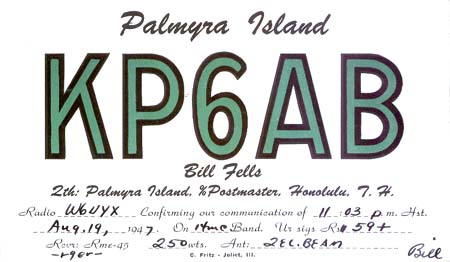
A friend of mine, who lives in El Dorado County and knows I’m a ham, had seen some QSL cards at a friend’s house and asked if he could give them to me. The envelope had five or six cards in it, all old but not a lot that interested me, with one exception.
The rather non-descript card, above, was printed by the same printer, and uses the same style, as one of my first QSL cards for my original call-sign, WB6EUQ. That, however, is not what caught my attention.
What made me notice this card was the callsign, itself. The card is dated, 1947, and has a “KP6” prefix, which at the time was assigned to Palmyra Island, now usually referred to as Palmyra Atoll, in the North Pacific Ocean, near the equator. The “KP” prefix is now assigned only to the Caribbean US Insular Areas, which include Navassa Islands (KP1), Virgin Islands (KP2), Puerto Rico (KP3 and KP4), and Desecheo Island (KP5).
In 1947, however, the “KP6” prefix was assigned to Palmyra Island, which is now in what is considered the Hawaii and Pacific Insular Areas. Palmyra and Jarvis Island are now assigned the prefix “KH5”. Kingman Reef is also assigned the Prefix, KH5, but with the “5” followed by a “K”.
What this all means today is if you decide you’re going to build your dream home on Palmyra Atoll, you can get assigned a KH5 call. There’s just one problem, however: Palmyra Atoll, administered by the Department of the Interior, has been a National Wildlife Refuge since 2001, so there’s no chance you or anyone else can get assigned a KH5 call-sign. It is possible to operate on Palmyra, once you get through a mile of red tape. If you do, it will either by with your call with “/KH5” after it or with a 1×1 special event call-sign, such as K5P. There is simply no way to get assigned a KH5 call-sign.
Here’s what Wikipedia and the CIA World Fact Book has to say about how Palmyra is governed:
Palmyra Island is an incorporated territory of the United States (the only such territory in existence since 1959), meaning that it is subject to all provisions of the U.S. Constitution and is permanently under American sovereignty. However, since Palmyra is also an unorganized territory, there is no Act of Congress specifying how Palmyra should be governed. Palmyra is also uninhabited, as far as permanent residents are concerned. Palmyra Atoll is part privately owned (The Cooper Family still owns two of the five smaller “Home Islands” and the Nature Conservancy purchased the majority of the atoll for conservation and research, acting as a key manager alongside the government.) and part federally owned; the Office of Insular Affairs of the US Department of the Interior continues to administer nine excluded areas comprising certain tidal and submerged lands within the 12 nm territorial sea or within the lagoon
Bill Fells, the licensee of KP6AB, was obviously in the Navy or a Navy contractor, since Palmyra Atoll was under the jurisdiction of the Department of the Navy from 1934 until 1947. At the time, those in the Navy, or contracted by the Navy, did qualify for a mailing address on Palmyra Atoll, which is why Bill got his KP6AB license. Somehow, Bill’s QSL card made its way to El Dorado County. If anyone knew Bill, please let me know.